

Custom Large Spacers: Professional Solutions for UK Projects
Imagine you've spent the weekend meticulously tiling your kitchen splashback, only to find your plug sockets are now buried deep behind the new wall surface. It’s a common frustration for UK homeowners when standard, flimsy plastic bits just won't bridge the gap properly. Finding a custom large spacer that actually fits your specific backbox can feel like an impossible task, especially when industrial suppliers make the process so needlessly complex for a simple home project.
We agree that there's nothing more irritating than a wobbly socket or an unsightly gap that ruins a beautiful renovation. You deserve a finish that looks like it was crafted with care, rather than a makeshift solution that feels brittle. This article will help you identify, measure, and source the perfect custom large spacer to ensure a professional, flush finish for your home improvements. We'll explore how to get your measurements spot on and why a bespoke approach is the simplest way to get your UK-standard fittings looking their absolute best. It’s all about achieving that crisp, artisanal look without the industrial headache.
You can design your perfect custom fit spacer now with the Build My Spacer tool on our new site: socketspacers.com.
Key Takeaways
- Understand why bespoke components are superior to standard washers when bridging significant gaps behind your wall plates.
- Spot the specific renovation scenarios, from kitchen splashbacks to timber panelling, that require a custom large spacer for a tidy result.
- Learn how to accurately measure the depth of your wall recess to ensure your new fittings sit perfectly flush with the surface.
- Explore how modern 3D printing provides a precise, eco-friendly way to create custom-sized solutions without the need for expensive industrial tooling.
Table of Contents
What is a Custom Large Spacer and Why Does Size Matter?
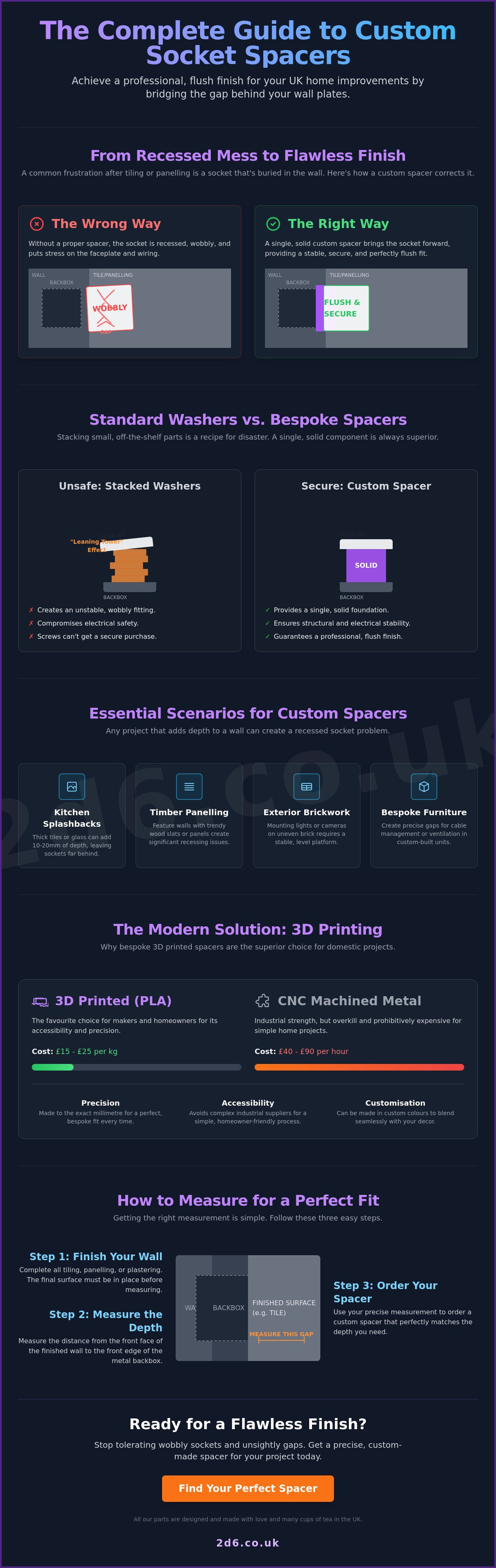
At its heart, a custom large spacer is a bespoke piece of kit designed to bridge the void between two surfaces that just won't meet. While you might be familiar with the basic idea of what is a spacer?, these larger versions are specifically tailored in depth and diameter for unique UK home projects. These aren't your typical off-the-shelf washers; they're precise solutions for when a standard fix falls short. A custom spacer acts as a vital bridge that ensures both electrical safety and structural stability for your fixtures.
They become essential during those big kitchen renovations where thick tiles or splashbacks leave your sockets recessed far too deeply into the wall. Instead of a wobbly, unprofessional finish, these components provide a solid foundation for your faceplates. Whether you're dealing with a single socket or a complex multi-gang setup, getting the size right is the difference between a job that looks "DIY" and one that looks truly professional.
The Difference Between Standard and Large Spacers
Standard spacers found in your local DIY shop usually stop at a measly 5mm or 10mm. If your new wood panelling adds 25mm to the wall, those little rings just won't cut it. Stacking multiple small spacers is a significant safety risk; it creates a "leaning tower" effect that compromises electrical stability and makes the socket feel loose. A single, solid socket backing spacer provides the necessary surface area to support heavy faceplates without any flex or movement. This ensures the screws have a firm, continuous path to the backbox.
Materials Matter: PLA vs. Industrial Metals
For domestic, non-load-bearing projects, 3D printed PLA is the favourite choice amongst makers and homeowners. While industrial metals like aluminium are incredibly strong, they're also heavy and expensive to produce for a one-off fix. Verified 2026 data shows that UK CNC machining for aluminium can cost between £40 and £90 per hour, whereas 3D printing filaments like PLA cost roughly £15 to £25 per kilogram. This makes 3D printing a much more accessible way to get an exact, millimetre-perfect custom large spacer. We can even offer custom colours so the part blends into your decor, all made with love and many cups of tea.
Essential Scenarios Requiring a Large Custom Spacer
Home improvements often throw up unexpected hurdles that standard hardware just can't clear. A kitchen renovation is a classic example. When you've invested in beautiful new tiles or a thick glass splashback, you're often adding 10mm to 20mm of depth to your walls. This leaves your plug sockets feeling like they're retreating into the masonry. A custom large spacer provides the necessary bulk to bring that socket back to the surface, ensuring everything sits flush and looks intentional rather than accidental. This focus on a professional finish is also essential in commercial catering spaces, where TFSE Products Ltd provide high-quality food display solutions that respect both modern standards and the rich history of the industry. Beyond the kitchen, feature walls using trendy wood panelling or acoustic slats create similar depth challenges that standard washers simply can't handle.
External projects also benefit from these bespoke solutions. Brickwork is rarely perfectly flat, and mounting a light or a security camera directly onto an uneven surface can lead to a wobbly finish or water ingress. By using a spacer tailored to your specific requirements, you create a stable, level platform. These components are often produced using additive manufacturing, which allows for complex shapes that match your fixtures perfectly. This modern approach is also brilliant for bespoke furniture projects where you might need precise gaps for cable management or ventilation without compromising the piece's aesthetic.
Solving the Recessed Socket Problem
If you've ever seen a socket that looks like it's "floating" inside a hole in the tiles, you know how unprofessional it looks. It's also a safety concern. Screws must reach the backbox securely whilst maintaining a rigid connection. Using dedicated socket spacers for thick walls ensures that the faceplate is properly supported from behind. This prevents the plastic from cracking when you tighten the screws and keeps the whole assembly rock-solid during daily use.
Custom Spacers for Multi-Gang Fittings
The challenge grows when you're dealing with double or triple gang light switches. Trying to align three or four individual ring spacers behind a single long faceplate is a recipe for frustration. They slip, they slide, and they rarely sit at the same depth. A single, solid plate is a much better way to organise your installation. Our custom multi-gang faceplate spacers are designed to fit the entire footprint of your switch, providing a uniform mounting surface that makes alignment effortless. If you're struggling with a particularly tricky layout, feel free to reach out to us for a bit of friendly advice on your specific project.
Measuring and Selecting the Perfect Spacer for Your Project
Getting your measurements right is the most important part of the job. A custom large spacer needs to be spot on to avoid putting unnecessary stress on your electrical wires or terminals. If the spacer is too shallow, you'll still have a gap. If it's too deep, you might strain the connections when you force the faceplate back. Accuracy ensures the safety of your home and the longevity of your fittings, providing a solid foundation that standard, flimsy alternatives simply can't match.
-
Step 1: Measure the depth of the recess from the finished wall surface back to the metal lugs on the backbox.
-
Step 2: Identify your screw size. For almost all UK electrical fittings, this is a standard M3.5 screw.
-
Step 3: Determine the outer dimensions. You want the spacer to be large enough to provide support but small enough to remain hidden behind the faceplate.
If you're ready to fix that recessed socket once and for all, you can customise your light switch or socket spacer here to your exact specifications.
Tools You Will Need for Accuracy
While a simple ruler works, digital callipers are the favourite choice for anyone wanting a truly professional result. They allow you to measure to the nearest millimetre with ease. If you're dealing with uneven surfaces like rustic tiles or thick plasterwork, it's wise to take measurements at several points. We often recommend a "dry fit" method; try cutting a small piece of scrap wood or cardboard to your measured depth to see how it sits before ordering your final part. This small bit of manual effort prevents mistakes and ensures a perfect fit first time.
Common Pitfalls to Avoid
One common mistake is ordering a spacer that is too wide. Modern faceplates often have clips or internal ribbing that can be obstructed if the spacer footprint is too large. Another thing to check is your screw length. When you add a custom large spacer of 20mm or more, your standard 25mm screws won't reach the backbox anymore. You'll likely need 40mm or 50mm M3.5 screws to complete the task safely. Finally, avoid over-tightening. You want the socket to be firm, but cranking the screws down too hard can put pressure on the backbox lugs or the spacer itself. Our spacers are sturdy, but a gentle touch is always best for electrical components.
Why Bespoke 3D Printed Spacers are the Modern Solution
Traditional manufacturing often leaves homeowners in a lurch. If you need a single custom large spacer for a bespoke project, industrial firms often demand high minimum orders or charge hefty tooling fees. 3D printing changes this. It allows us to print exact millimetre dimensions without the need for expensive moulds or complex setups. This makes bespoke solutions accessible for everyone, from professional electricians to weekend DIY enthusiasts who just want a job done right.
Sustainability is also at the heart of what we do. We use eco-friendly PLA plastic for our household fixes, which is a plant-based material derived from renewable resources. It is a durable, reliable choice for non-load-bearing applications like socket extensions. By choosing a 3D printed solution, you are opting for a process that minimises waste whilst supporting a UK maker who actually understands the quirks of British electrical standards and regional building styles.
The 2d6 Designs Craftsmanship
At our studio, we organise every print run to ensure total precision. We don't just hit 'start' and walk away. Each custom large spacer is monitored and checked to ensure it meets our high standards for quality and fit. This artisanal approach is a world away from cold, mass-produced industrial manufacturing. We take pride in the manual effort behind every order, ensuring that even a functional item like a spacer receives the attention to detail it deserves. You can find our full range of light switch and socket spacers in our shop, where each one is handled with genuine care.
Ordering Your Custom Solution
Getting your bespoke part is a straightforward process. Once you have measured your recess depth and checked your screw size as discussed earlier, simply provide those details when you order. We handle the rest, from the digital design to the final print. We offer reliable UK-wide shipping, so your solution arrives quickly and safely at your door without the fuss of dealing with industrial suppliers. If you have a particularly unusual requirement or a complex multi-gang setup, please contact us to discuss your custom project today. We are always happy to help a fellow maker achieve that perfect, flush finish.
Achieve the Perfect Finish for Your Home
Achieving a professional finish shouldn't be a struggle. By taking precise measurements of your recess and choosing a custom large spacer tailored to your project, you can banish wobbly sockets forever. Whether you're navigating a thick kitchen splashback or a stylish wood-panelled feature wall, the right support ensures your electrical fittings are both safe and beautiful. We've seen how accuracy with M3.5 screws and the use of eco-friendly PLA can transform a tricky DIY task into a simple, satisfying fix.
We take immense pride in our work. Every order is hand-finished in the UK to ensure it meets our exacting standards. With hundreds of glowing customer reviews, we've helped countless homeowners find bespoke designs for any UK socket type. You don't have to settle for standard parts that don't quite fit your vision.
Ready to get started? Browse our range of custom UK socket spacers and find the perfect match for your home. Your renovation deserves that crisp, artisanal touch that only a bespoke solution can provide. Good luck with the rest of your project!
Frequently Asked Questions
Are plastic spacers safe for use behind electrical sockets?
Yes, plastic spacers are perfectly safe for providing mechanical stability behind your wall plates. They are non-conductive and don't interfere with the electrical current or wiring. Their primary role is to ensure the faceplate remains rigid and doesn't flex when you plug in an appliance, which helps prevent the socket from cracking or becoming loose over time.
What is the maximum depth a custom large spacer can handle?
We can produce a custom large spacer at depths up to 50mm to suit even the most extreme renovation projects. Most domestic needs fall between 15mm and 30mm, but our 3D printing process allows for significant flexibility. If you have a particularly deep recess created by thick panelling or acoustic slats, we can tailor the depth to your exact millimetre requirements.
Do I need longer screws if I use a large spacer?
You will almost certainly need longer screws when using a custom large spacer for your home improvements. Standard UK socket screws are typically 25mm long, which won't have enough reach once you've added a thick spacer and new tiles. We recommend sourced M3.5 screws in 40mm or 50mm lengths to ensure they grab the backbox lugs securely through the additional depth.
Can I get a custom spacer for a double socket or a triple switch?
Yes, we specialise in bespoke plates designed specifically for double sockets and multi-gang light switches. Using a single, solid plate is much easier than trying to align multiple individual rings behind a large fitting. It provides a uniform mounting surface that keeps everything level and flush against your new wall finish, ensuring a professional look for complex setups.
What material are your large spacers made from?
Our spacers are crafted from PLA, which is a plant-based, eco-friendly plastic. It's a durable material that provides excellent compression strength for non-load-bearing household fixes like socket extensions. This material allows us to create precise, bespoke shapes that fit your UK-standard backboxes perfectly without the high cost and waste associated with industrial manufacturing.
How do I know what size spacer I need for my kitchen tiles?
The best way to check is to measure the distance from the front surface of your new tiles back to the screw lugs on the backbox. Use a ruler or callipers to get an accurate reading in millimetres. It's always wise to measure at both sides of the socket to account for any slight variations in the plaster or adhesive depth before you place your order.