

PLA Material: A Complete Guide to the Sustainable Future of 3D Printing
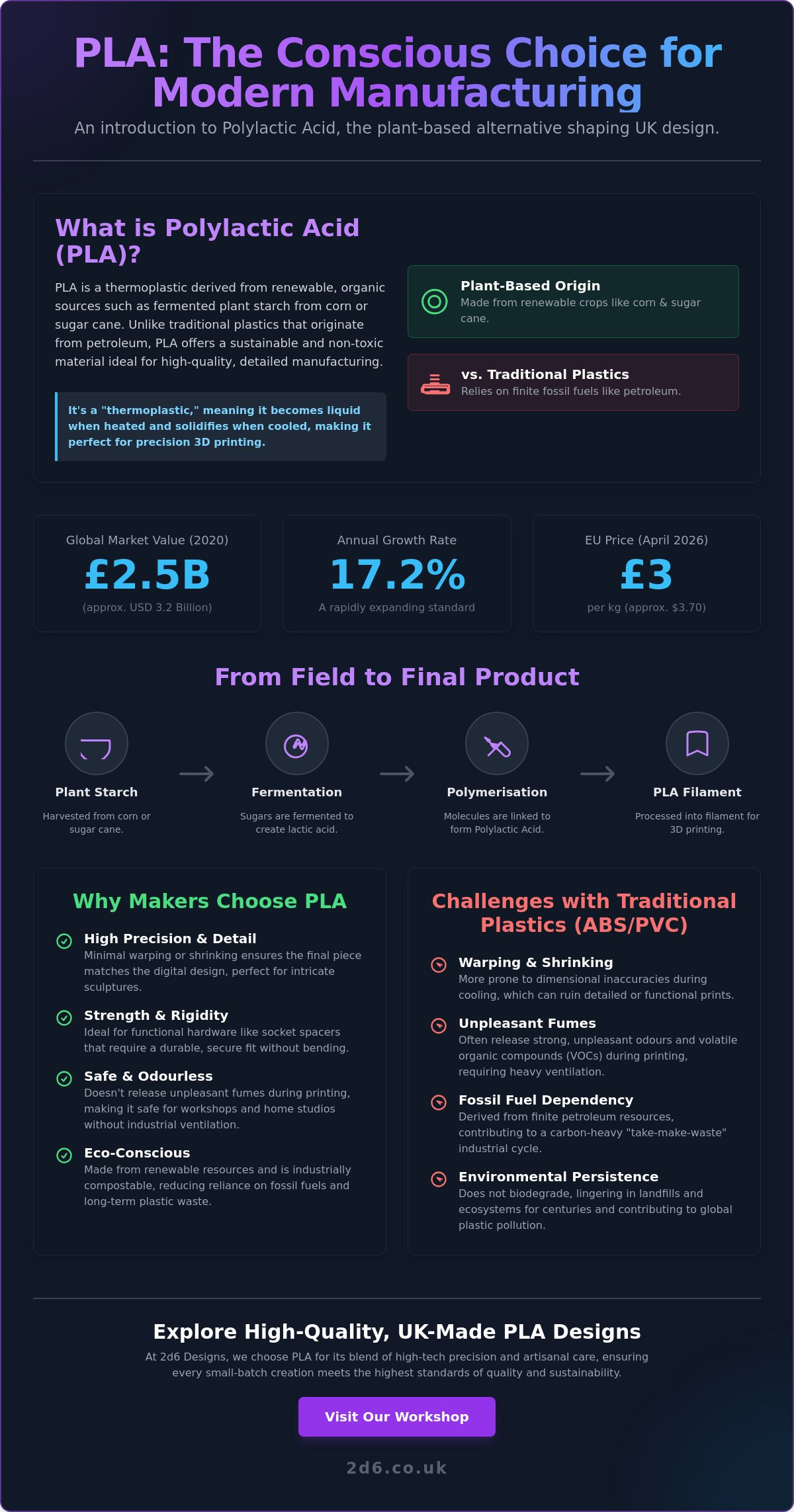
The era of generic, petroleum-based plastic is ending, replaced by a revolution that smells faintly of sweet popcorn and looks like high-end art. Many of us feel a pinch of guilt when buying new home accessories, wondering if our latest purchase adds to the global waste problem. You probably already know that traditional plastics linger for centuries, but pla material offers a refreshing, plant-based alternative that doesn't compromise on quality. With the global PLA market valued at USD 3.2 billion in 2020 and growing at a rate of 17.2% annually, this is no longer a niche hobbyist trend; it is the new standard for conscious British manufacturing.
If you've ever felt confused by technical jargon or worried that "eco-friendly" means "flimsy," you aren't alone. We promise to show you why PLA is the leading choice for high-quality home decor and functional hardware right here in the UK. This guide explores how this material, currently priced between $3.66 and $3.74 per kg in Europe as of April 2026, transforms from corn starch into durable sculptures and reliable socket spacers. We will look at its safe, non-toxic nature and its surprising strength for daily use. It's about bringing artisanal care into your home, made with love and many cups of tea.
Key Takeaways
- Understand how PLA is derived from fermented plant starch like corn or sugar cane, offering a renewable alternative to petroleum-based plastics.
- Discover the true environmental impact of pla material and the specific industrial composting conditions required for it to safely biodegrade.
- Learn why the high dimensional accuracy and rigidity of PLA make it the ideal choice for durable home hardware, such as custom-fit socket spacers.
- Explore how 3D printing allows for a blend of high-tech precision and artisanal care in creating bespoke, detailed sculptures for your home.
- Find out why choosing small-batch, UK-made production ensures better quality and attention to detail than traditional mass-produced imports.
What is PLA Material? An Introduction to Sustainable Bioplastics
The plastic in your old milk jugs or window frames likely started its life in an oil well, but this material begins in a field. PLA stands for Polylactic Acid, and it's a thermoplastic monomer that has completely changed how we think about manufacturing. Unlike traditional plastics, most pla material used in 3D printing today comes from fermented plant starch. In the UK, this usually means corn or sugar cane. It is a renewable resource that feels much more at home in a modern, eco-conscious British household than the heavy, oil-based alternatives of the past.
Contrast this with ABS (Acrylonitrile Butadiene Styrene) or PVC. These older plastics often release unpleasant fumes during the printing process and rely heavily on finite fossil fuels. PLA is different. It has become the backbone of the UK maker movement because it's approachable, safe, and versatile. Whether you're a hobbyist working in a spare bedroom or a professional workshop like ours, it's the material that makes high-quality, sustainable creation possible without needing industrial-grade ventilation. Understanding the properties of pla material helps us bridge the gap between high-tech manufacturing and artisanal care.
To better understand this concept, watch this helpful video:
The Science of Polylactic Acid
The journey from a cornfield to a 3D-printed sculpture is a clever bit of chemistry. Manufacturers take plant sugars and ferment them to create lactic acid. Through a process called polymerisation, these molecules are linked together to form Polylactic acid (PLA). It's a "thermoplastic," which simply means it turns into a pliable liquid when we heat it up and sets back into a solid when it cools down. This cycle can be repeated many times, making it incredibly useful for precision work. Long before it took over the 3D printing world, it was already a staple in medical implants and food packaging because it's safe and predictable.
Why PLA is the Favourite for Modern Makers
We choose it for our workshop because it allows for an incredible level of detail that other materials simply can't match. When we're crafting something intricate like a sausage dog line art sculpture, we need the material to behave perfectly. PLA doesn't warp or shrink like other plastics, so the finished piece looks exactly like the digital design. It also comes in a stunning array of finishes that suit any British home. You can choose a sleek matte for a modern, understated look or a shimmering silk finish for something more eye-catching. For functional items like our socket spacers, its rigidity ensures a secure, flush fit every single time. It's the perfect choice for a "maker-to-consumer" relationship where quality and attention to detail are the top priorities.
Is PLA Truly Eco-Friendly? Understanding the Environmental Impact
When we talk about being eco-friendly, it's easy to get lost in marketing buzzwords. Many people assume that because pla material is plant-based, it will simply vanish if left in the garden. The reality is a bit more nuanced, but it remains a far better choice for the planet than traditional plastics. By choosing a material grown in a field rather than pumped from an oil well, we are already making a significant dent in our environmental footprint. It's about moving away from the "take-make-waste" industrial model and towards something that feels more like a responsible, circular craft.
Renewable Origins vs Petroleum
Traditional plastics like ABS or PVC rely on finite fossil fuel resources, which means every gram produced adds to a carbon-heavy cycle. PLA is different because it's made from annually renewable crops. Whether it's corn starch or sugar cane, these plants absorb carbon dioxide as they grow, offsetting a portion of the emissions created during manufacturing. This creates a much lower carbon footprint. In fact, producing PLA requires significantly less energy than conventional oil-based polymers. Because these crops can be replanted year after year, we aren't depleting the earth's ancient reserves to create your home decor or hardware. It's a cleaner, more sustainable way to bring new objects into your life without the heavy weight of environmental guilt.
The Reality of Biodegradability
There is a common misconception that 3D-printed items might start to crumble on your shelf. Rest assured, your pla material is incredibly stable in a typical home environment. It won't degrade if it gets wet or sits in the sun. To break down, PLA requires the specific, high-temperature conditions found in industrial composting facilities. As of August 2026, the EU Packaging and Packaging Waste Regulation (PPWR) has standardised these requirements, ensuring that products marketed as compostable meet the strict EN13432 standard. This means that whilst your PLA items won't break down in a garden compost heap, they can be processed by professional facilities into water and carbon dioxide.
For a responsible British household, the best end-of-life option is to check with your local council about their bioplastic recycling capabilities. Many UK regions are expanding their food waste and industrial composting services to handle these modern materials. If you're looking for a simple way to upgrade your home sustainably, our custom-fit socket spacers are a great example of how this plant-based tech can solve everyday problems with a much lighter touch on the planet.
Key Properties: Strength, Finish, and Durability in the Home
Choosing the right material for your home is about finding a balance between beauty and brawn. Whilst some plastics feel cheap or industrial, pla material has a premium, rigid feel that lends itself perfectly to both functional hardware and delicate art. One of its greatest strengths is dimensional accuracy. This means that when we print a light switch socket spacer, it fits with a level of precision that mass-produced plastic injection moulding often misses. It doesn't warp or curl as it cools. Every edge remains sharp and every surface stays flat, which is vital for hardware that needs to sit flush against your wall.
This rigidity provides excellent structural integrity. Unlike softer plastics that might flex or bend under pressure, PLA holds its shape firmly. It is this "stiffness" that makes it so reliable for items that need to stay put. Whether it's a custom bracket or a decorative piece, you can trust that it won't sag over time. It bridges the gap between high-tech manufacturing and the kind of sturdy, dependable items you'd expect from a traditional British workshop.
Why PLA Looks Better Than Other Plastics
If you've ever looked closely at a 3D-printed object, you'll know that the finish is everything. PLA is celebrated amongst makers for its ability to hold incredible detail. This makes it the ideal choice for our line art sculptures, where every curve of a sausage dog or a couple's silhouette needs to be crisp and clean. Because it takes pigments so well, the colours are vibrant and deep. You aren't limited to basic primary shades; you can find everything from subtle mattes to shimmering silks. There are even specialty blends that include real wood fibres or stone powders, giving you the look of traditional materials with the precision of modern tech.
Understanding Heat and Durability
Every material has its limits, and for PLA, that limit is heat. It has a glass transition temperature, which is the point where it starts to soften, of roughly 50 to 60 degrees Celsius. In a domestic setting, this is rarely an issue. It's perfectly safe for use behind a light switch or as a wall sign. These areas simply don't reach those temperatures in a normal home. However, it is the reason you won't see us making tea mugs or dishwasher-safe containers out of it. Boiling water would cause it to lose its shape almost instantly.
For indoor use, PLA is surprisingly hardy. It has good resistance to UV light, so your favourite geeky gifts won't go brittle or yellow just because they're sitting on a sunny windowsill. It's a material designed for the long haul in a typical British home, providing a sustainable solution that looks just as good ten years from now as it does the day it arrives in the post.
PLA in the Home: From Electrical Spacers to Artistic Sculptures
While many people still view 3D printing as a niche hobby for tech enthusiasts, the reality is that pla material has quietly become a staple for high-quality, finished goods in the British home. It is a material that bridges the gap between industrial utility and artisanal beauty. One of the most significant benefits for families is that PLA is generally non-toxic and emits a slightly sweet, organic scent when processed, rather than the harsh chemical fumes associated with traditional plastics. This safety profile makes it the perfect choice for items that live on your coffee table or sit behind your electrical faceplates.
Functional Fixes: Socket and Switch Spacers
If you have ever tiled a kitchen or added wood panelling to a room, you'll know the frustration of "recessed" sockets. When the wall becomes thicker, the electrical box stays put, leaving your socket faceplate hovering precariously or sunken into the wall. This is where the rigidity of pla material becomes a lifesaver. Because we can print with a precision of 0.1mm, we create socket spacers and extension plates that provide a rock-solid, flush finish.
Unlike makeshift DIY solutions that use stacks of washers or cut-up bits of plastic, a dedicated PLA spacer is designed for the exact dimensions of UK backboxes. You can even choose a colour that matches your wall or faceplate, ensuring the fix is invisible. It is a professional, permanent solution that handles the pressure of being screwed tight without cracking or warping, which is essential for maintaining a safe and tidy home.
Decorative Art and Geeky Merchandise
Beyond the toolbox, PLA allows us to create objects that were once considered physically impossible to manufacture. Traditional injection moulding requires "draft angles" and simple shapes so the part can pop out of a metal mould. 3D printing has no such limits. This freedom is what brings our line art sculptures to life. We can produce minimalist, continuous-line designs that appear to float in the air, capturing the essence of a family bond or a favourite pet with incredible elegance.
This same technology makes PLA the ultimate choice for geeky gifts and magnets. Whether it is a complex geometric puzzle or a custom nameplate, the material holds fine details that feel crisp to the touch. Because we produce these in small batches right here in our UK workshop, every piece receives the care and attention it deserves, ensuring that your "geeky" decor feels like a premium piece of art rather than a mass-produced toy.
Browse our full range of bespoke socket spacers to finish your home renovation with professional precision and a perfectly flush fit.
The 2d6 Designs Approach: Why We Choose PLA for Our Workshop
At 2d6 Designs, we don't just see a spool of plastic; we see the potential for a unique piece of home decor or a vital household fix. Our commitment to using high-quality pla material is rooted in our belief that high-tech manufacturing should never lose its human touch. By choosing this plant-based polymer, we ensure that every item leaving our workshop aligns with our values of sustainability and precision. We avoid the "one-size-fits-all" approach of mass-produced imports, opting instead for a maker-to-consumer relationship that puts quality and attention to detail at the forefront of everything we do.
Supporting British Makers
There is a distinct advantage to buying locally made goods. When you choose a British maker, you're supporting a more circular economy that values craftsmanship over sheer volume. Our quality control process is rigorous. Because we print in small batches, we can inspect every single layer of a print to ensure it meets our exacting standards. If a piece isn't perfect, it doesn't ship. This hands-on approach allows us to offer personalised customer service that big-box retailers simply can't match. Every order is handled with genuine care, meticulous attention, and a deep-seated pride in the finished product.
We know that when you're in the middle of a home renovation, you don't want to wait weeks for a part to arrive from overseas. That's why we pride ourselves on fast UK dispatch. Whether you're ordering a single spacer or a whole set of sculptures, we aim to get your items to your door as quickly as possible. It's about providing a reliable, local solution for the modern British home that doesn't compromise on speed or ethics.
Custom 3D Printing with PLA
Sometimes, a standard product isn't quite what you need. Perhaps you have a specific vision for a piece of office decor or a unique technical challenge that requires a bespoke part. We love working on custom projects. Our workshop is equipped to handle everything from one-off prototypes to personalised items like the ultimate Twitch nameplate. The versatility of pla material means we can iterate quickly, turning your digital ideas into physical objects with minimal waste.
If you have an idea that needs to be brought to life, we invite you to get in touch. Whether it's for a "geeky" subculture or a professional corporate setting, we can help you find the right solution. Visit our about page to learn more about our story, or head straight to the shop to see our latest creations in action. Let's build the sustainable future of your home together, one layer at a time.
Start Building a Greener, Better-Fitting Home
PLA has proven itself as a versatile, renewable powerhouse that doesn't sacrifice performance for its eco-credentials. From the rigidity required for electrical spacers to the delicate curves of minimalist line art, this plant-based material is reshaping British interiors. By choosing pla material, you are supporting a cleaner manufacturing process that replaces finite oils with annually renewable crops like corn and sugar cane. It is a choice that feels right for the modern, conscious household, proving that high-tech solutions can still have a heart.
At 2d6 Designs, we take pride in every layer we print. With over 1,000 satisfied customers across the country, we have seen first-hand how small-batch, UK-made production can solve everyday problems with meticulous care. Whether you need a functional fix or a unique gift, you can trust that our products are crafted to last. Explore our range of handcrafted PLA home solutions and discover the difference that artisanal 3D printing can make in your space. It's time to embrace a future where your home accessories are as kind to the planet as they are beautiful to look at.
Frequently Asked Questions
Is PLA material safe for use in my home?
Yes, PLA material is exceptionally safe for domestic use because it is derived from natural, plant-based sources like corn starch. Unlike traditional oil-based plastics that can off-gas harmful chemicals, PLA is non-toxic and produces no dangerous fumes during or after production. This makes it an ideal choice for families and pets, ensuring your home environment remains healthy whilst you enjoy your unique decor or functional hardware.
Will PLA melt if it is used behind a light switch or socket?
No, PLA will not melt in a standard electrical setting as it remains solid until reaching its glass transition temperature of approximately 50 to 60 degrees Celsius. Most domestic light switches and sockets operate at ambient room temperatures, well below this threshold. We have designed our spacers to handle the typical conditions of a British home, providing a rigid and reliable fit that stays perfectly in place for years without warping.
How long do PLA products last before they start to degrade?
Your PLA products will last for decades if kept in a typical indoor environment. Whilst the material is technically "biodegradable," this process only triggers under the intense heat and microbial activity of industrial composting facilities. On a shelf or behind a wall, it is incredibly stable and won't show signs of wear or degradation. You can expect your sculptures and hardware to maintain their structural integrity for the lifetime of your decor.
Can PLA be recycled in my standard UK kerbside bin?
Currently, most UK local authorities do not accept PLA in standard kerbside recycling bins because it can contaminate traditional plastic streams like PET. Instead, it should be sent to industrial composting facilities that meet the EN13432 standard. We recommend checking with your specific council or visiting a specialist recycling centre. As bioplastic infrastructure grows, more regions are expected to include these materials in their food and organic waste collections.
Is PLA material stronger than traditional plastic?
PLA material is significantly more rigid than many traditional plastics, which gives it excellent structural integrity for items like socket spacers. Whilst it is stiffer than materials like ABS, it can be more brittle if subjected to heavy impact or extreme bending. For most home applications, its strength is more than sufficient, providing a rock-solid feel that doesn't flex or sag under the pressure of everyday use.
What happens if I leave a PLA product in direct sunlight?
In a standard indoor setting, direct sunlight through a window won't harm your PLA items. The material has good natural UV resistance, so it won't turn yellow or go brittle like some older plastics. However, you should avoid placing it in areas that reach extreme temperatures, such as a car dashboard in mid-summer. As long as it stays below 50 degrees Celsius, it will keep its shape and colour perfectly.
Does PLA material smell or emit fumes?
During the printing process, pla material is famous amongst makers for its pleasant, slightly sweet scent that many compare to popcorn or pancakes. Once the product is finished and reaches your home, it is completely odourless and emits no harmful VOCs or fumes. This clean profile is one of the main reasons we choose it for our workshop, ensuring our workspace and your home stay fresh and safe.
Is PLA food-safe for kitchen items?
Whilst the raw plant-based resin is often classified as food-safe, 3D-printed items have tiny ridges between the layers where bacteria can hide. Additionally, the low heat resistance of the material means it cannot be cleaned in a dishwasher, which often reaches temperatures between 45 and 75 degrees Celsius. For these reasons, we recommend using our PLA products for decorative and functional home purposes rather than direct food contact or kitchen utensils.