

Choosing the Best Back Box Extender for Your UK Home Renovation
Last Saturday, Sarah finished tiling her new bathroom, only to discover that her sockets were suddenly buried too deep for the screws to reach. It's a common frustration for the 72% of Britons planning home improvements in 2026, where a few millimetres of extra wall thickness can ruin an otherwise perfect finish. This is where a back box extender becomes the essential tool for the job, bridging the gap between your electrical box and the new surface safely.
We agree that a beautiful room shouldn't be let down by exposed gaps or wobbly faceplates that don't sit flush. You'll learn exactly how to fix recessed electrical sockets safely whilst achieving a professional finish that complies with the mandatory BS 7671:2018+A4:2026 regulations. We'll explore the different types of spacers available and show you why a custom-fit solution is often the simplest way to get your renovation back on track, made with love and many cups of tea.
You can design your perfect custom fit spacer now with the Build My Spacer tool on our new site: socketspacers.com.
Key Takeaways
- Identify exactly when a back box extender is required to bridge the gap created by new tiling, plastering, or decorative panelling.
- Compare the benefits of traditional metal extension boxes against modern plastic spacers to find the most discreet fit for your domestic renovation.
- Master the safe technique for measuring the depth of your recessed socket to ensure you achieve a professional, flush result every time.
- Ensure your project meets the latest UK electrical safety standards by eliminating dangerous gaps between the faceplate and the wall surface.
- Explore how bespoke 3D-printed solutions provide a millimetre-perfect finish that standard off-the-shelf hardware simply cannot match.
Table of Contents
- What is a Back Box Extender and When Do You Need One?
- Comparing Extension Solutions: Metal Boxes vs. Plastic Spacers
- How to Measure for Your Back Box Extender
- Safety and Compliance: Staying Within UK Electrical Regulations
- Why Bespoke 3D-Printed Spacers are the Professional DIY Choice
What is a Back Box Extender and When Do You Need One?
When you're knee-deep in a kitchen renovation, it's the little details that often catch you out. You've spent hours choosing the perfect tiles, but once they're on the wall, your electrical sockets look like they've retreated into a cave. A back box extender is a simple, clever frame designed to bridge the gap between your existing electrical box and the new wall surface. To understand the foundation of your home's wiring, it helps to know What is a Back Box, as these containers house the vital connections that keep your home powered and safe.
The primary use for these spacers is to bring the socket faceplate forward when walls are thickened. This happens most often during tiling, plastering, or the installation of decorative wood panelling. A recessed socket isn't just an eyesore; it makes it difficult to plug in appliances and can leave dangerous wiring exposed to dust and debris. Whilst some try to solve this by simply using longer screws, this often leaves the internal components unsupported. A proper extension ensures the entire assembly is rigid and secure.
Signs You Need an Extension Solution
You'll know you need a fix if your socket faceplate feels "floating" or wobbly after you've finished decorating. If there's a visible gap between the wall surface and the metal box inside, or if your standard 35mm screws no longer reach the lugs, it's time for a proper solution. With 72% of Britons planning home improvements in 2026, many will face this exact issue when adding modern finishes to older properties.
The Importance of a Flush Finish
Achieving a flush finish isn't just about aesthetics, though a professional look is vital to avoid that "DIY mistake" feel. A tight seal prevents dust ingress and ensures the faceplate sits flat against the wall, which is a key requirement for electrical safety. Under the BS 7671:2018+A4:2026 regulations, which become mandatory for all new work from 15 October 2026, maintaining the integrity of these enclosures is essential. Using a dedicated socket spacer provides the structural support needed for frequent plugging and unplugging, keeping your home both beautiful and compliant.
Comparing Extension Solutions: Metal Boxes vs. Plastic Spacers
Choosing the right hardware for your project is about more than just filling a gap; it's about matching the solution to your specific environment. While a trade professional might instinctively reach for a heavy-duty metal frame, a homeowner finishing a kitchen splashback or a feature wall usually needs something more refined. The goal is to find a back box extender that provides structural support without becoming a bulky eyesore that interferes with your decor.
When to Use Metal Extension Frames
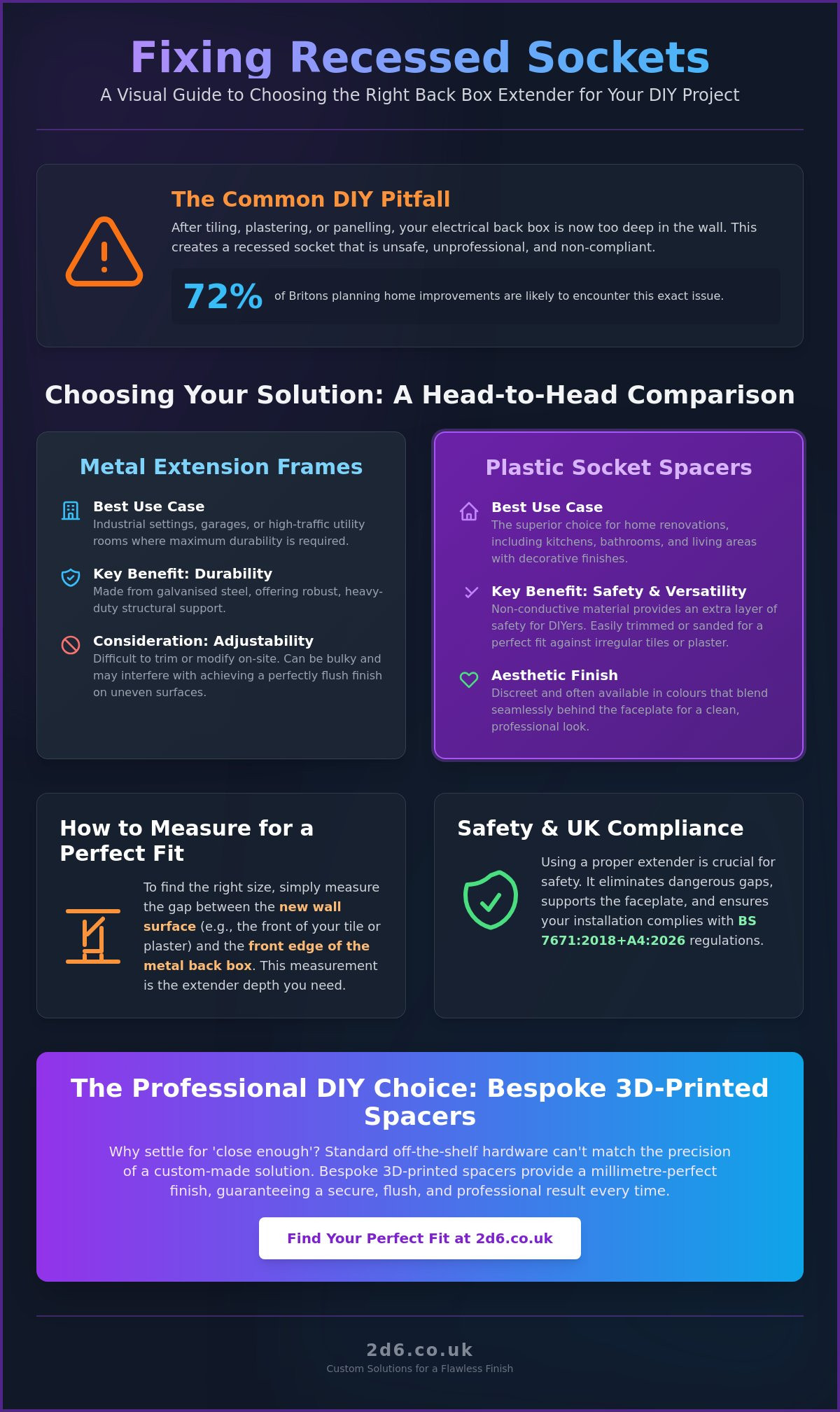
Metal extension frames are the heavy hitters of the electrical world. Typically made from galvanised steel, they are best suited for industrial settings or situations where you are extending a surface-mounted pattress box in a high-traffic area like a garage or utility room. They offer incredible durability, but they can be difficult to work with in tight domestic spaces. If your renovation involves specific wiring zones that require earthed metal enclosures, these are often the go-to choice. However, for a standard indoor room, their thickness can sometimes make it harder to get the faceplate to sit perfectly flush against the wall.
The Benefits of Plastic Socket Spacers
For the vast majority of UK home renovations, plastic is the superior choice for several practical reasons. Firstly, non-conductive materials provide an extra layer of safety for DIYers working within the framework of UK Electrical Regulations. Plastic is also much easier to trim or sand down if you are working amongst irregular tile edges or slightly uneven plasterwork. Unlike metal, these spacers are often available in various colours, allowing them to blend seamlessly behind the edges of your faceplates rather than standing out.
You might have seen stackable plastic rings in local hardware stores, which usually cost between £1.25 and £1.35 for a 10mm depth. While they are accessible, they can feel incredibly flimsy if you are forced to stack three or four together to reach your required depth. A wobbly stack of plastic rings makes it difficult to keep the socket level and secure during use. This is why many people are turning to bespoke 3D-printed solutions. A custom-made back box extender provides a single, solid piece of hardware that matches your exact millimetre requirements, ensuring the socket stays firm for years to come.
If you are tired of fiddling with multiple thin rings that never quite line up, you might want to explore our collection of custom-fit socket spacers for a more stable and professional alternative that is tailored to your specific wall thickness.
How to Measure for Your Back Box Extender
Before you even reach for a tape measure, safety is the absolute priority. Head to your consumer unit and switch off the power to the relevant circuit. It's a small step that prevents a massive headache. Once you're sure the power is dead, you can start the process of fitting your back box extender. Measuring accurately is what separates a professional, high-end finish from a messy bodge job that you'll regret every time you plug in the kettle.
You'll need a simple ruler or a depth gauge to find the distance from the metal edge of the box to the finished surface of your new wall. Whether you've added 10mm of tile or 12.5mm of plasterboard, precision matters. Following the latest IET Wiring Regulations ensures your installation isn't just tidy, but legally compliant too. This is especially vital as we move towards the mandatory October 2026 standards, where every millimetre of enclosure integrity counts.
One detail that often trips people up is the faceplate lip. Most UK sockets have a slight recess on the back, usually between 1mm and 3mm deep. If your gap is exactly 15mm and you buy a 15mm spacer, you might find the faceplate doesn't sit quite right. We usually recommend choosing a spacer that is about 1mm thinner than your total gap to allow for this. This ensures the faceplate pulls tight against the wall rather than being pushed away by the spacer hardware.
Step-by-Step Measuring Guide
Start by removing the faceplate screws and gently pulling the socket forward, taking care not to strain the wires. Measure the distance from the front edge of the back box to the new wall surface at several points. In the UK, you'll generally be looking for either 1 gang or 2 gang options. Select a spacer that matches this depth as closely as possible to ensure a snug, flush fit that looks like it was installed by a specialist tradesperson.
Dealing with Non-Standard Depths
What do you do if your gap is 13mm, but you can only find 10mm or 20mm spacers at the local DIY shop? Many people try doubling up thin spacers, but this often leads to a wobbly finish and compromises screw stability. Given that 36% of homeowners have delayed projects because they couldn't find a tradesperson, taking the DIY route with a back box extender is a great move, but only if you have the right parts. For unique UK home projects, custom-fit socket spacers are the best choice to bridge those awkward intermediate gaps without the fuss or wobbly layers.
Safety and Compliance: Staying Within UK Electrical Regulations
Safety is the most important factor when you're updating your home's electrical fittings. One of the most critical requirements in UK building standards is the "flush face" rule. Essentially, the front edge of your electrical enclosure must sit flush with the finished wall surface. When you add tiles or panelling, you create a gap that breaches this enclosure. A back box extender isn't just for looks; it restores the integrity of the box, ensuring that any heat or sparks are safely contained within a non-combustible frame.
Leaving a gap behind your faceplate creates a genuine fire risk. In the event of a loose connection or a minor electrical fault, sparks could easily reach flammable materials like wooden wall battening, wallpaper, or the paper backing of plasterboard. The back box is designed to be a fire-rated container, but it can only do its job if there are no exit points for heat. Relying on extra-long screws without a proper spacer is also a recipe for mechanical failure. Without the support of a frame, the leverage from plugging and unplugging appliances can easily snap the brass lugs inside your back box; this leaves you with a loose, dangerous socket that requires a much more expensive repair.
Part P and DIY Electrical Work
In England and Wales, Part P of the Building Regulations governs electrical safety in dwellings. Whilst major work like installing a new circuit requires a certified electrician, simple tasks like replacing a faceplate or adding a back box extender are generally considered non-notifiable work that you can tackle yourself. You must still ensure the work is safe and compliant with UK Electrical Regulations. Always check that any accessory you install is made from fire-retardant materials. If you feel even slightly unsure about the wiring amongst your new wall finish, it's always best to consult a professional to verify your work.
Common Installation Mistakes to Avoid
- Pinched Wires: Ensure that no cables are trapped between the edge of the back box and the spacer frame, as this can damage the insulation over time.
- Over-tightening: It's tempting to crank the screws down, but this can crack your faceplate or the spacer itself. Aim for a firm, snug fit instead.
- Incorrect Width: Using a spacer that is too wide for the faceplate can interfere with your tiling or leave an ugly visible edge.
If you want to ensure your renovation meets these safety standards whilst looking its absolute best, you can buy our custom-fit back box extension plates to get a millimetre-perfect, compliant finish for your home.
Why Bespoke 3D-Printed Spacers are the Professional DIY Choice
Mass-produced options from big-box retailers often fall short because they only cater to standard 10mm or 20mm depths. If your new kitchen splashback has left you with a 14mm gap, a standard back box extender from a high-street shop won't provide the snug fit you need. This is where bespoke 3D printing changes the game for UK homeowners. By choosing a custom-fit solution, you receive a single, solid piece of hardware designed for your specific wall thickness, rather than a wobbly stack of plastic rings.
Our approach bridges the gap between high-tech manufacturing and artisanal care. We use durable, high-quality PLA and specialised plastics to ensure every piece provides the structural integrity required for daily use. We take pride in the handmade nature of our products; even though they are 3D-printed, the human effort behind the machine ensures every order meets our high standards of quality. This maker-to-consumer relationship means you aren't just buying a plastic frame; you're investing in a piece of hardware built with genuine conscientiousness.
The 2d6 Designs Difference
Our socket spacers solve the problems that generic hardware misses by offering millimetre-perfect precision. We understand that a home is a reflection of personality, which is why we offer the ability to match spacers to your unique decor. Whether you prefer a sleek, minimalist look or something that celebrates your geeky side, we have you covered. A light switch spacer is just as important as a socket fix. Using the same high-quality spacers across all your fittings creates a cohesive, professional feel that truly elevates a renovation project.
Ordering Your Custom Spacers
Ordering your bespoke hardware is a simple, friction-free process. Once you've used our measuring guide to determine the exact depth of your recessed box, you can provide those measurements directly with your order. Because we are a small-scale, UK-based enterprise, we can offer fast UK dispatch that large-scale imports often struggle to match. This localised service means you get personal customer support from people who actually understand the technicalities of the product.
Every order is handled with care and attention, ensuring your project stays on track without the frustration of ill-fitting parts. You can explore our full range of electrical accessories for your next project, knowing that each piece reflects our commitment to British craftsmanship. By choosing a custom back box extender, you're not just fixing a socket; you're supporting local makers and ensuring a safe, beautiful finish for your home.
Achieve a Professional Finish for Your Renovation
A successful home renovation is often defined by the small details that ensure safety and style go hand in hand. Precision matters. You've learned that a wobbly socket isn't just an eyesore; it's a breach of the BS 7671:2018+A4:2026 electrical standards that become mandatory on 15 October 2026. By choosing a precision-made back box extender, you bridge the gap between your new wall surface and the electrical box, preventing fire risks and protecting your wiring for years to come.
Instead of struggling with generic, ill-fitting hardware from high-street shops, you can opt for a solution that's tailored to your exact needs. Our products are made in the UK using precision 3D printing, which allows us to offer custom depths for any renovation project. With fast UK dispatch on all our electrical accessories, you won't have to wait long to put the finishing touches on your beautiful new space.
Ready to get that flush, professional look? Browse our collection of custom-fit socket spacers for a perfect finish. You've done the hard work of decorating; now let's make sure the hardware lives up to your high standards.
Frequently Asked Questions
Can I use a back box extender for both light switches and plug sockets?
Yes, you can use the same type of extender for both light switches and plug sockets because they follow identical standard UK mounting dimensions. Whether it's a single light switch or a double plug socket, the screw holes are spaced the same distance apart. This makes it easy to maintain a consistent, professional finish across your entire room whilst ensuring all your electrical points sit flush against the new wall surface.
Is it safe to use plastic back box extenders instead of metal ones?
Plastic extenders are perfectly safe and often preferred for domestic renovations because they are non-conductive. This provides an extra safety buffer for DIY projects compared to metal alternatives. As long as the material is fire-retardant and complies with general safety standards, such as the Electrical Equipment (Safety) Regulations 2016, a plastic back box extender is a reliable and compliant choice for your home.
How many spacers can I safely stack together if the gap is very deep?
You should avoid stacking multiple thin spacers as it can lead to a wobbly, unstable socket that feels flimsy during use. Whilst some people try to stack two or three 10mm rings, it's difficult to keep them perfectly aligned. For gaps deeper than 10mm, a single bespoke spacer is the professional choice. It ensures the faceplate remains rigid and secure, preventing the mechanical failure of the back box lugs over time.
Do I need a different extender for a 1 gang vs a 2 gang socket?
Yes, you must choose an extender that matches the specific gang size of your electrical fitting. A 1 gang socket is typically 86mm square, while a 2 gang socket is approximately 146mm wide. Using the wrong size will prevent the faceplate from sitting correctly and could leave dangerous gaps. Always measure the width of your faceplate before ordering to ensure you get a snug, professional fit that covers the entire opening.
What length of screws do I need when using a 10mm back box extender?
You'll typically need 40mm or 50mm M3.5 screws to account for the extra depth provided by a 10mm spacer. Standard UK socket screws are usually 25mm or 35mm long, which won't be enough to reach the lugs once the spacer is in place. Buying a slightly longer screw ensures you have enough thread to grip the back box securely without over-tightening and risking damage to the faceplate or the spacer.
Will a back box extender help if my wall is crumbling around the socket?
An extender provides a flat, solid surface for the faceplate to sit against, but it won't fix structural damage to the wall itself. If your plaster is crumbling, you should use a repair plate or filler alongside your back box extender. This combination ensures the socket is physically supported and that the faceplate hides any messy edges, giving you a clean and safe finish that looks like a professional trade job.
Do back box extenders come in different colours to match my decor?
Most mass-produced spacers found in trade shops only come in white or clear plastic, which can look out of place against darker paint or tiles. However, bespoke 3D-printed versions can be crafted in various colours to blend seamlessly with your specific decor. This is a great way to ensure your electrical points don't stand out as a "DIY fix" but rather look like a deliberate, handcrafted part of your room's design.
Are these extenders compatible with all UK standard back boxes?
Yes, these extenders are designed to fit standard BS 4662 back boxes, which are the national standard for almost all UK homes. Whether you have a plastic dry-lining box in a stud wall or a metal flush box in a brick wall, the mounting holes will align perfectly. This universal compatibility makes them a straightforward solution for nearly any domestic renovation project across the country, from modern builds to period properties.